
Over the Fortress
And into a whole new world...

On November 9, 2016, the day after Donald Trump was elected president of the United States for the first time, I booked two flights to Cuba for me and my husband. I don’t want to give Trump too much credit for making me click the purchase button on the JetBlue website; for years, Cuba had been the chair I was circling. Trump’s election was the music stopping.
I never thought to call myself Cuban American despite the deep roots that my maternal line planted into Cuban soil. In my fertile imagination, the embargo was an actual iron fortress rising out of the crashing ocean waves to surround the island, rendering Cuba unreachable to me and the rest of the world. Once, completely oblivious to the gravitas of what I doing, I asked my mother if she ever wanted to return to Cuba. She responded firmly, No. The Cuba she knew didn’t exist anymore.
But that means now there is another Cuba to get to know, I thought, filing the idea of a trip to Cuba under S for someday.
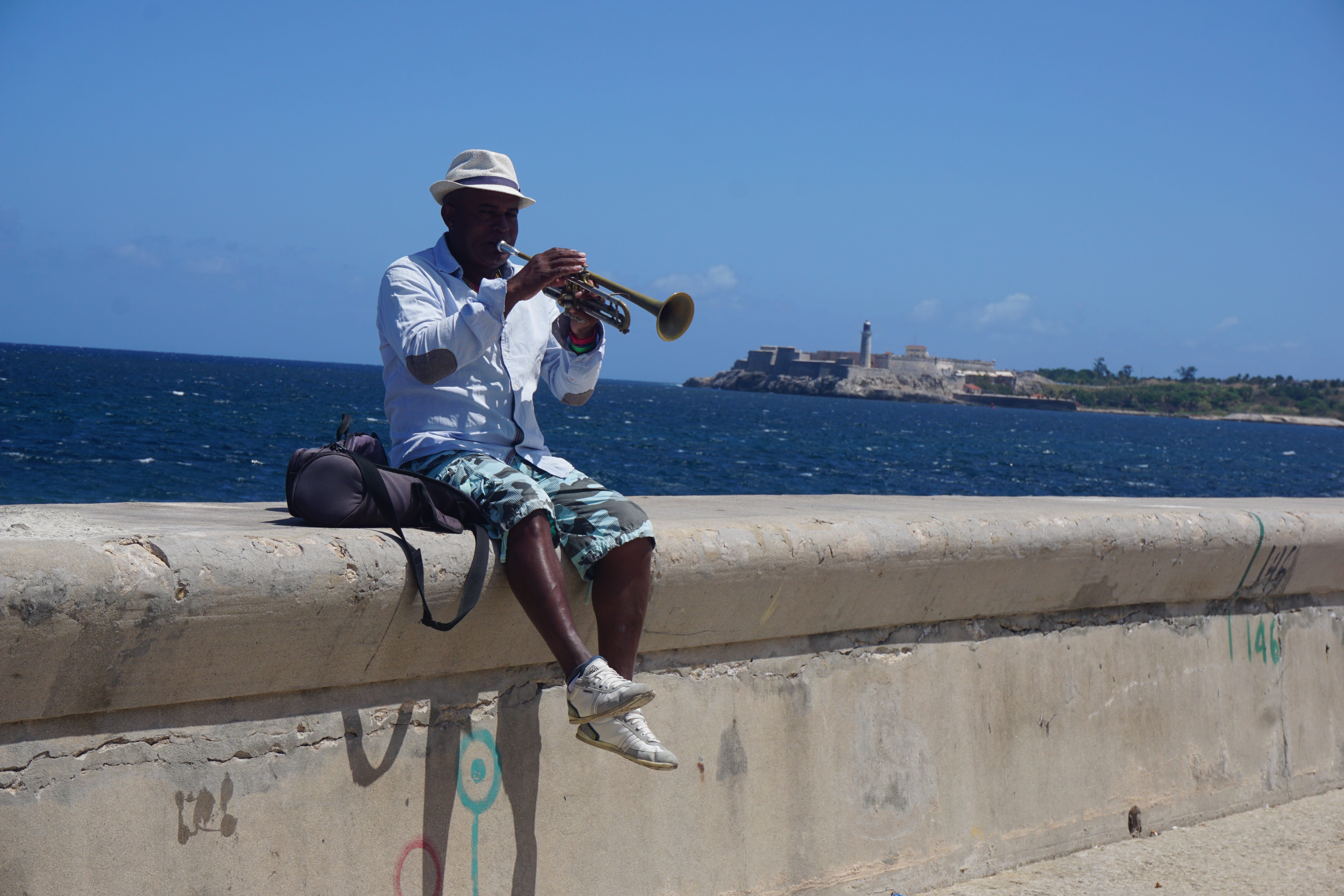
Fast forward through my college years, through moving to New York, through apartments in Brooklyn and Queens, to a snowy Monday morning in January 2016. Stomping the snow off my boots and removing my scarf without strangling myself, I waited for the elevator at my Bryant Park office building. A colleague from another department, someone I tolerated and worked with but didn’t like very much, whipped out her phone to the audience captive in the elevator to show off a photo of herself taken in Havana the previous Friday evening. She had traveled to Havana for the weekend. For the weekend? The photo showed my colleague seated in the back of a hot pink 1950s convertible. She raised a mojito in one hand and flash a peace V with the other. The top was folded down to show off Havana’s famous sea wall known as the Malecon and the colonial Spanish fort El Morro in the distance.
Based on the reactions of everyone else in the elevator, I was the only one who saw the driver of the car, slightly blurry in the foreground. A Cuban man probably in his thirties in a New York Yankees baseball cap and long sleeved light blue shirt, he leaned to the side, trying to get out of the way of the camera. In contrast to my colleague’s wide grin with her tongue pinched between her teeth, the driver’s lips were drawn tight, his eyes focused on something off in the distance, his stoic unreadable face a stark contrast to the expressive faces of my Cuban family and friends.
I swallowed the urge to strangle her with her scarf and instead asked where she went in the bubblegum pink car, she answered nowhere with a huge laugh. She tipped him one US dollar for the photo and carried on while the car and its pensive driver waited for the next tourist, hopefully one that wanted to hire him as a driver for the day. Through the angry blood rushing through my ears, I heard her tell someone else that she was glad to get back to the cruise ship because Havana was very dirty and polluted and the food was terrible.
I stayed on the elevator past my floor, to the top of the building, where the grand terrace usually reserved only for events and corporate parties was dark and still. I shed my heavy winter coat, hat, and gloves and leaned against the icy cold window. I looked out over a snowy Bryant Park and listened to the distinct sounds of New York City muffled by snow. And I tried not to go blind with rage.
My Abuelito, the man who never skipped siesta and loved chocolate ice cream, was told by Castro’s police that their Cuba was no longer his Cuba. My grandmother, the woman who taught me how to make arroz con pollo and regularly attends water aerobics even now in her nineties, hasn’t seen her homeland in nearly seventy years. I don’t speak Spanish because people like my family and countless other artists, scholars, writers, and journalists were arrested, imprisoned, tortured, and killed in the impressive Spanish colonial fort just behind my colleague’s raised mojito.
OH MY GOD, HOW DARE YOU?
You went to Cuba but you didn’t GO to Cuba. Your eyes might have been opened behind sparkling sunglasses that cost more than most Cubans take home in a month but you didn’t SEE Cuba. Even after setting foot on Cuban soil and feeling the Cuban heat on your skin, you have never BEEN to Cuba. And, maybe worst of all, you have no clue that Cuba means something else to me than it does to you.
Cuba deserved better than this. The heavy iron doors on the imaginary fortress were not going to slam shut on me, my heritage, and the future generations of my family who needed the blood-deep connection to our island home. I wedged my foot in, flew over the fortress, and realized that the iron walls were all in my head. Setting foot on Cuban soil, I was not a selfie-stick wielding idiot but a long-lost daughter returning home. The sights, the smells, the sounds of Havana were as familiar to me as the sandy South Carolina foothills where I grew up and as the sidewalks of Queens where I now live because those little pieces of Cuba have always been present in my heart, soul, and mind since the day I was born.
Now I understand every day that it is my duty to go over that fortress, to prove that no dictator can separate me from my heritage, to live as a traveler - not a tourist - with open eyes, to greet the foreign as familiar, to let the blurred face of a stranger come into focus, to not look away when my heart opens and breaks at the loss I see there, and to tell everyone that if I have little pieces of a foreign place in myself then so do you, my friend. Zoom out and see the mosaic made of those little pieces. See how beautiful it is.
Beautiful. Luis and I were married in El Morro ❤️ When Luis asked Cuba's "White House" for permission to hold our ceremony there, he was told no American had ever done so before. We weren't granted permission until the day before, but it was worth the wait. A violinist played Ave Maria from the corner of the small cathedral as Cuban and American guests filed in and took their seats on the wooden benches. Two priests, one who spoke Spanish and one who spoke English, officially brought our lives, families and cultures together. Such a special place, forever embedded in my DNA.
I write this with tears in my eyes, as the daughter of an undocumented immigrant. Thank you for expressing so beautifully what I feel in my heart. The place our forebears are from is in our genes. The knowledge of that soil, that air, the flora and fauna, the shapes and textures of a place we never experienced until adulthood - it's in us, and when we are there at last, we KNOW this place. It is the puzzle we're made of, and the pieces all fit.